


Kabir Wins Prize in Global Essay Competition
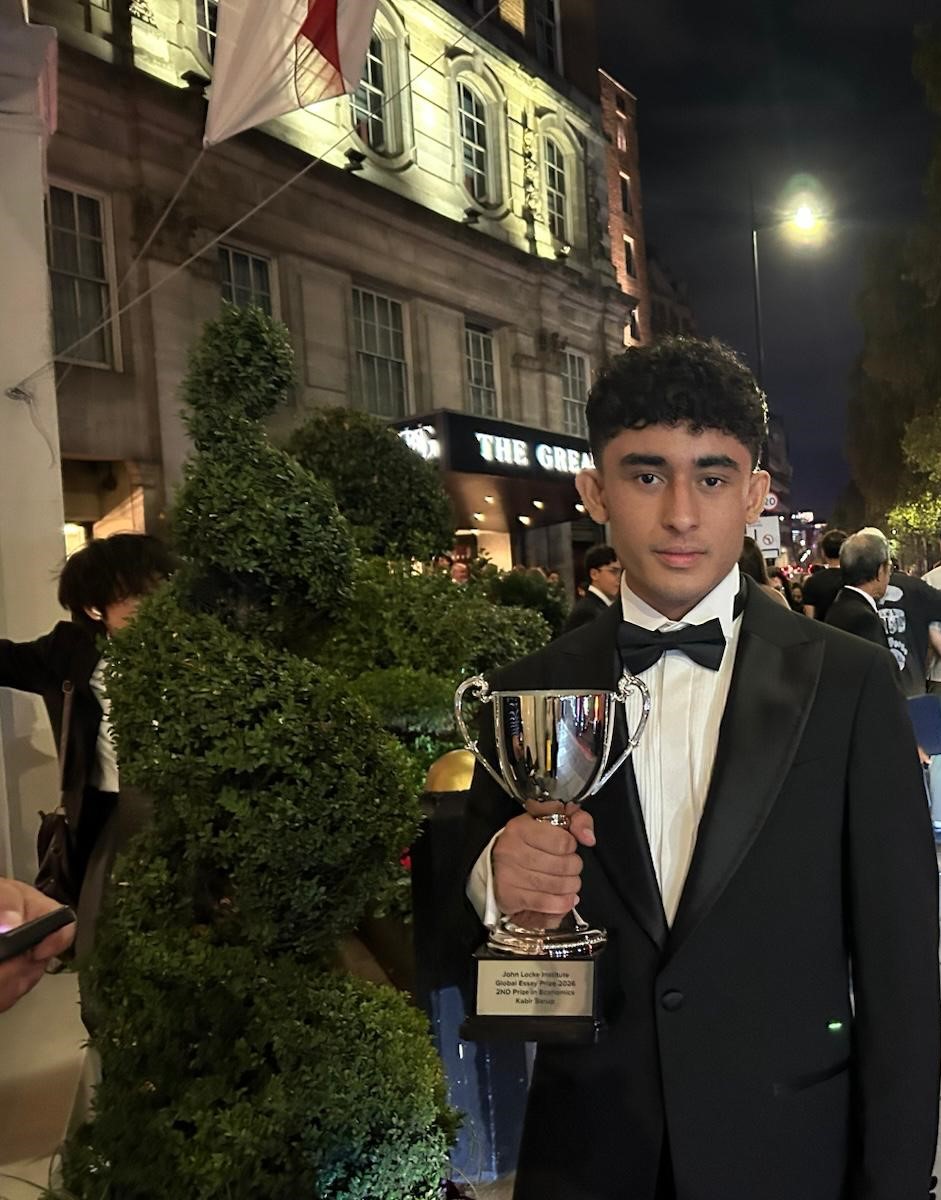
Congratulations to Year 13 student Kabir, awarded Second Prize in Economics in the John Locke Institute’s 2026 Global Essay Prize at the Awards Ceremony and Gala Dinner took place on Saturday 3 October at the Grosvenor House Hotel, London.
Mr David Johnson, Head of Economics and Business at Pate's said,
"The Economics department is immensely proud of Kabir. We encourage all our students to engage in the super-curricular activities, and this is just one of the many brilliant pieces he has in his portfolio of work. There is no higher accolade than being recognised in a global competition like this so well done Kabir!"
Kabir is studying Economics, Maths, Further Maths and Physics and is a leader of the Pate’s Economics Society. He is applying to read Economics at university next year, with hopes of securing a place at a top UK university. He shares his story of this success below,
"The John Locke Institute is an independent educational organisation, and its annual essay prize is widely regarded as one of the most prestigious/competitive essay competitions in the world for school-age students. Entry is free and open to students from any country who are under 19 on the submission deadline. Each year the Institute sets three questions in each of ten subjects, from Economics and Law to Philosophy and Theology. Entrants answer in no more than 2,000 words. Essays are judged by a panel of academics from universities including Oxford, Cambridge, Harvard, Princeton, and Stanford. This year’s competition drew 100,227 entries from students in 183 countries.
I first came across the competition online and entered for the opportunity to develop economic reasoning beyond the A level syllabus.
I chose the Economics question Technology now allows personalised pricing. If this came to be widely used, what effects should we expect? My argument was that the personalised pricing firms can carry out is not the textbook case of charging every customer exactly what they are willing to pay. It is a much finer-grained version of the familiar practice of charging different groups different prices. It moves money from consumers to firms in a way that tends to hit the consumers least willing to walk away the hardest. I argued it gives everyone a strong reason to hide or muddy the data that the pricing relies on. The centre of the essay was a model showing that when consumers all respond in this way, firms end up knowing no more about any individual than they did at the start, so the system quietly undermines the very data it depends on.
Essays were submitted by the end of May, and in July I found out I had been shortlisted (after an online interview). The shortlist was the top 17.5% of entries. The next stage was a longer discussion of the whole essay with an economics lecturer from the University of Edinburgh, and then a conversation with the Director General of the Institute and former lecturer of Economics at the University of Oxford, Martin Cox.
Prizes were only announced at the the awards ceremony itself. The Awards Ceremony and Gala Dinner was a black-tie dinner, with the top 3 in each subject, as well as grand prize, read out on the night. So I went into the dinner knowing nothing beyond the shortlist and the interview. Hearing my name read out in a ballroom full of students from around the world was simply surreal. It was gratifying to know that the arguments I’d been turning over in my head had held up in front of a panel of academics with far more experience than me.
From this experience, what I learnt to appreciate the most was the gap between knowing economic theory and using it surgically. I had to decide which models actually applied, where they broke down, and build my own answer from there. The interview taught me something else. Defending the essay line by line forced me to reason out loud, from every angle. That is a fundamentally different skill from writing, and one I’ll need just as much at university.
I would strongly recommend to other students that they enter this competition. It’s free and open to anyone under 19. Being shortlisted is an achievement in itself, putting you in the top fifth of over 100,000 entries. Pick the question that interests you most, because you’ll be wrestling with it for months (you can enter more than one). Read the original sources but ensure the essay and its arguments are your own."


